
Input, Injected-Intelligence, Output Framework
Organisational Flow in the Age of Inorganic Intelligence From Input → Injected Intelligence → Output
Organisations are undergoing a structural shift.
Where once value was created through linear human labour pipelines, today it increasingly emerges from the injection of inorganic intelligence (AI) into organisational flow.
This paper proposes a simple but powerful operating model:
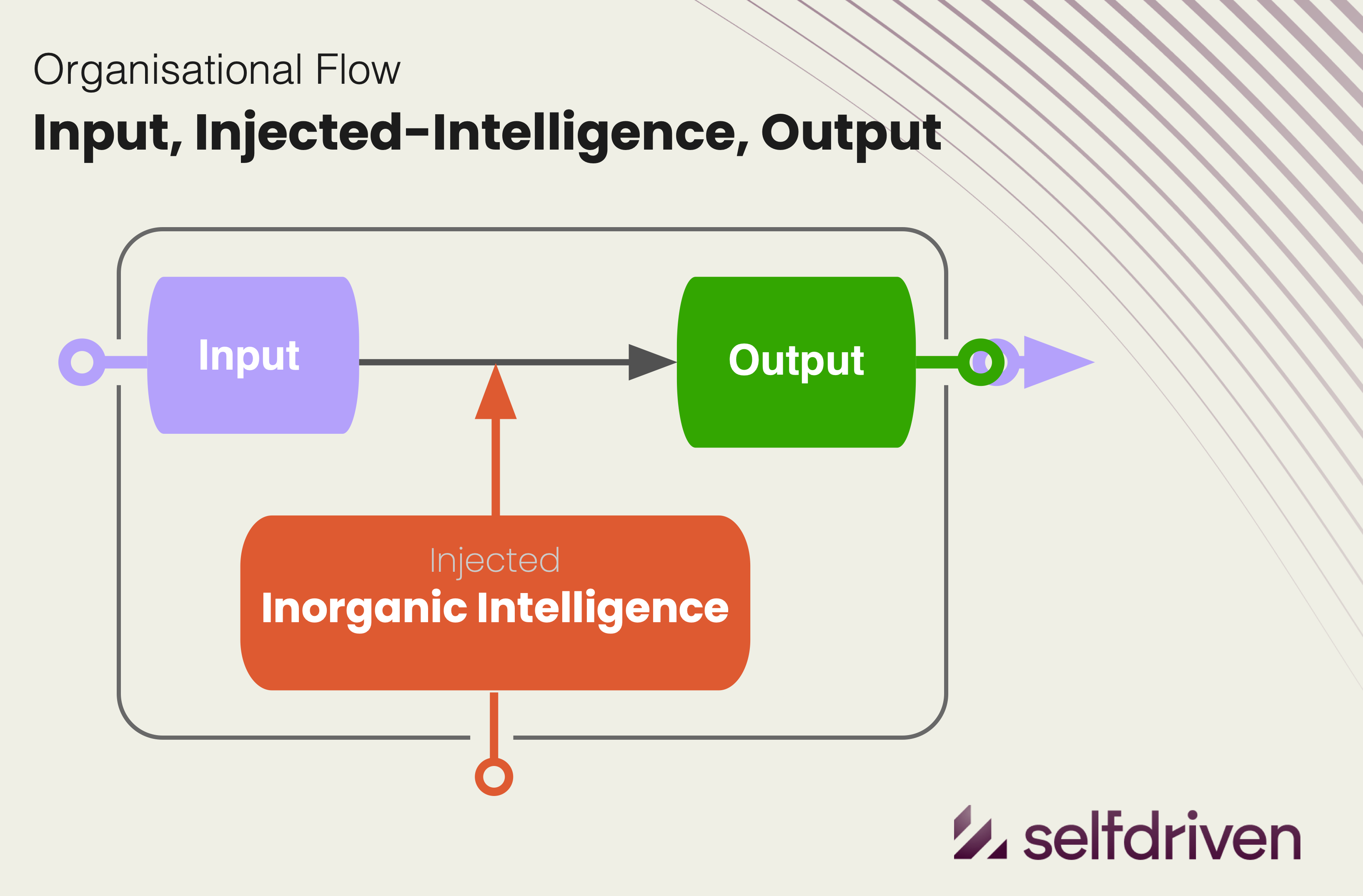
Input → Injected Inorganic Intelligence → Output
This model reframes organisations not as collections of roles and departments, but as flows of intent, context, and verification, with intelligence acting as an augmenting layer rather than a replacement for human agency.
1. The Legacy Organisational Model (Why It Breaks)
Traditional organisations are designed around:
- Human labour as the primary processing unit
- Hierarchies as coordination mechanisms
- Time and effort as proxies for value
Classic flow:
Human Input → Human Processing → Human Output
This model assumes:
- Scarcity of intelligence
- High cost of cognition
- Linear scaling (more people = more output)
AI breaks all three assumptions.
2. Defining the New Flow
The Core Pattern
Input → Injected Inorganic Intelligence → Output
Where:
- Input = intent, data, context, constraints
- Injected Inorganic Intelligence = AI systems applied at specific points in the flow
- Output = decisions, artefacts, actions, proofs, or services
The key shift is injection, not replacement.
3. What Counts as “Input” Now
In modern organisations, input is no longer just tasks or tickets.
Valid Inputs Include:
- Human intent (“what we are trying to do”)
- Context (policies, history, constraints)
- Signals (data, events, claims, sensor readings)
- Proofs (credentials, attestations, verifiable facts)
Crucially:
Input quality now matters more than input volume.
4. Injected Inorganic Intelligence (The Middle Layer)
This is not a monolithic “AI agent”.
It is selective, contextual intelligence injection.
Forms of Injection
- Pattern recognition
- Simulation and forecasting
- Classification and triage
- Drafting and synthesis
- Verification and consistency checking
- Decision support (not decision authority)
Think of AI as:
A high-bandwidth cognitive amplifier applied where friction exists.
5. Output Is No Longer “Work Done”
Outputs are not hours logged or documents produced.
Modern Outputs Include:
- Verified decisions
- Automated actions
- Structured artefacts (code, policies, plans)
- Proofs of compliance or correctness
- Reduced uncertainty
In many cases, the absence of work is the output
(e.g. no dispute, no claim, no exception).
6. Organisational Design Implications
6.1 From Roles to Flow Nodes
People stop being “doers” and become:
- Input curators
- Context providers
- Exception handlers
- Final signatories
- Ethical and strategic governors
6.2 From Departments to Pipelines
Departments dissolve into:
- Input pipelines
- Intelligence-augmented processing stages
- Output verification layers
6.3 From Management to Orchestration
Management shifts from: Assigning tasks
to: Designing where and how intelligence is injected
7. Control, Agency, and Responsibility
A critical principle:
Humans retain intent and accountability.
AI provides capability.
This requires:
- Clear ownership of inputs
- Explicit delegation boundaries
- Traceable outputs
- Auditable decision paths
Without this, organisations drift into opaque automation risk.
8. Failure Modes to Avoid
-
Over-injection
AI everywhere, clarity nowhere. -
Input neglect
Poor prompts, bad data, missing context. -
Output theatre
Producing artefacts without real-world impact. -
Agency collapse
No human willing or able to say “this is my decision”.
9. Why This Model Scales
This flow scales because:
- Intelligence is non-rival
- Injection points can be reused
- Human effort concentrates at leverage points
- Outputs improve without proportional headcount growth
It also de-risks adoption by keeping humans in control of intent.
10. The Core Insight
The future organisation is not:
- AI-run
- Agent-based
- Or fully autonomous
It is:
A human-intent system with injected inorganic intelligence optimising flow from input to output.
Organisations that understand this will out-learn, out-adapt, and out-deliver those still optimising for labour.
Mapping Organisational Flow to Engagement → Lab → Production
This paper maps the modern organisational flow
Input → Injected Inorganic Intelligence → Output
onto the Engagement / Lab / Production operating model.
The result is a structure that scales intelligence without collapsing human agency.
Core Alignment
The three stages are modes of operation, not departments.
ENGAGEMENT → LAB → PRODUCTION Input Injection Output
Each stage has a distinct relationship to:
- human intent
- inorganic intelligence
- risk
- accountability
1. Engagement = Input (Intent Capture)
Purpose
Translate human reality into machine-actionable input.
This is where meaning, legitimacy, and trust enter the system.
What Happens Here
- Intent is expressed
- Context is captured
- Constraints are clarified
- Ambiguity is surfaced early
- Legitimacy and consent are established
Typical Inputs
- Goals and desired outcomes
- Requirements and edge cases
- Policies, norms, values
- Claims, declarations, credentials
- User stories and problem statements
Role of Inorganic Intelligence
- Assistive only
- Summarisation and clarification
- Detection of missing context or conflicts
- Structuring messy human input
Key Rule
AI does not decide in Engagement.
Humans retain authorship and intent.
Engagement answers: “What are we trying to do, and why?”
2. Lab = Injected Inorganic Intelligence (Exploration & Shaping)
Purpose
Reduce uncertainty before committing to execution.
This is where intelligence is injected most heavily.
What Happens Here
- Options are explored
- Assumptions are tested
- Scenarios are simulated
- Drafts and prototypes are created
- Risks and failure modes are surfaced
Forms of Intelligence Injection
- Generative drafting
- Modelling and simulation
- Pattern discovery
- What-if analysis
- Design space exploration
- Policy, code, or process prototyping
Humans shift from doing to:
- steering
- constraining
- selecting
- evaluating
The Lab is where thinking scales, not output.
Outputs of the Lab
- Candidate solutions
- Structured artefacts
- Decision-ready options
- Known risks and constraints
- Reduced uncertainty
3. Production = Output (Execution & Assurance)
Purpose
Deliver reliable outcomes with minimal variance and maximum trust.
This is where risk is highest and behaviour must be deterministic.
What Happens Here
- Approved patterns are executed
- Systems run continuously
- Outputs are verified
- Exceptions are explicitly flagged
Role of Inorganic Intelligence
- Constrained automation
- Continuous verification
- Monitoring and anomaly detection
- Evidence and audit trail generation
AI in Production operates within strict bounds. Creativity gives way to repeatability.
Production answers: “Do it correctly, consistently, and provably.”
4. End-to-End Flow
ENGAGEMENT Human intent and context ↓ LAB Intelligence injection and exploration ↓ PRODUCTION Deterministic execution and proof
Feedback Loops (Critical)
- Production exceptions → Engagement (re-clarify intent)
- Production anomalies → Lab (re-test assumptions)
- Lab learnings → Engagement (improve future inputs)
These loops prevent silent failure and organisational drift.
5. Organisational Design Implications
People Are Repositioned, Not Replaced
-
Engagement
Humans as sense-makers and trust anchors -
Lab
Humans as system designers and evaluators -
Production
Humans as governors, auditors, and exception owners
Management Becomes Flow Design
Leadership shifts from:
- assigning tasks
to: - designing where intelligence is injected
- deciding where it must be constrained
6. Control, Agency, and Accountability
A non-negotiable principle:
Humans retain intent and accountability.
Inorganic intelligence provides capability.
This requires:
- explicit ownership of inputs
- bounded delegation to AI
- traceable outputs
- auditable decision paths
Without this, automation becomes ungovernable.
7. Failure Modes to Avoid
-
Over-injection
Intelligence everywhere, clarity nowhere. -
Input neglect
Poor intent, bad data, missing context. -
Output theatre
Artefacts produced without real-world impact. -
Agency collapse
No human willing or able to own decisions.
8. Why This Model Scales
This model scales because:
- intelligence is non-rival
- injection points are reusable
- human effort concentrates at leverage points
- output improves without proportional headcount growth
It also de-risks AI adoption by preserving human control.
9. One-Sentence Summary
Engagement captures intent.
Lab injects intelligence to reduce uncertainty.
Production delivers outcomes with proof.
10. Closing Insight
The future organisation is not agent-run or fully autonomous.
It is a human-intent system with selectively injected inorganic intelligence, optimised for flow, trust, and accountability.